The Complete VDR Due Diligence Checklist for Sell-Side M&A (2026)
The Complete VDR Due Diligence Checklist for Sell-Side M&A (2026) The call came in at 8:47 AM on a Tuesday. The buy-side managing director at a Chicago-based private equity firm had just kicked off confirmatory diligence on a $22M lower-middle-market manufacturing acquisition, and their quality
Quick answer
What should be in a VDR due diligence checklist?
A VDR checklist should include financials, legal records, contracts, customer data, HR files, tax returns, IP, IT, compliance, and Q&A logs.
Topics covered
- VDR Due Diligence Checklist Template
- Recommended VDR Folder Structure
- Documents Buyers Request First
- Common VDR Setup Mistakes
- AI Checks Before Inviting Buyers
How should a sell-side VDR be organized?
Use numbered folders for corporate, financial, tax, customer, contracts, HR, legal, IP, IT, compliance, insurance, and buyer Q&A materials.
Why does a VDR checklist affect deal value?
A clean checklist reduces buyer uncertainty, shortens confirmatory diligence, and lowers the chance of retrading after missing documents surface.
The Complete VDR Due Diligence Checklist for Sell-Side M&A (2026)
The call came in at 8:47 AM on a Tuesday. The buy-side managing director at a Chicago-based private equity firm had just kicked off confirmatory diligence on a $22M lower-middle-market manufacturing acquisition, and their quality of earnings team needed three years of serialized inventory cost records by end of week.
The sell-side advisor scrambled through seventeen folders across three cloud platforms, only to discover that the plant manager had been storing critical production records in a personal Dropbox. The deal did not fall apart that day, but the buyer's confidence did.
They came back with a revised LOI two weeks later, dropping the EBITDA multiple from 5.2x to 4.7x — a $1.1M valuation haircut directly attributable to a disorganized data room.
That scenario plays out in boutique advisory practices every quarter. The difference between advisors who close deals cleanly and those who grind through weeks of document firefighting almost always comes down to one thing: a structured, pre-packaged VDR due diligence checklist executed before the first buyer NDA is signed.
This guide provides every category, document type, and process checkpoint your sell-side team needs to build a bulletproof virtual data room in 2026.
Free Resource: Before populating your VDR, run a free due diligence evaluation report to surface financial red flags and structural gaps your advisory team should remediate before buyer access begins.
Why Most Sellers Enter Due Diligence Unprepared in 2026
The sell-side due diligence process has grown significantly more demanding over the past three years. Institutional buyers — particularly private equity firms operating in the lower-middle market — now conduct parallel financial, legal, and operational workstreams simultaneously, compressing timelines while increasing document volume expectations.
According to transaction data tracked by the Securities and Exchange Commission on registered M&A advisory activity, the average document request list in a middle-market acquisition now exceeds 280 line items, up from roughly 190 in 2021. That 47% increase in document complexity has not been matched by a proportional improvement in seller preparedness.
The 3 Most Common Document Gaps That Delay Closings
In our advisory experience working with boutique M&A firms, three categories account for the majority of diligence delays:
-
EBITDA reconciliation support — Sellers provide adjusted EBITDA numbers in their CIM without attaching ledger-level support files, forcing buyers to reconstruct the normalization bridge from raw general ledger exports. This alone can add two to three weeks to the financial diligence phase.
-
Customer contract redaction — Material customer agreements are uploaded with sensitive pricing, volume discount structures, or auto-renewal clauses still visible to the entire buyer group, rather than restricted to clean-team legal counsel.
-
Tax compliance gaps — State and federal tax filings that are missing amended returns, audit resolution letters, or R&D credit documentation under IRS guidelines create immediate red flags for buy-side accounting firms, triggering escrow holdback demands.
How Buyer Expectations Have Shifted Post-2024
Sophisticated buyers in 2026 do not reward sellers for producing documents reactively. They reward advisors who demonstrate that the company has been managed with institutional discipline — and a pre-packaged, well-organized VDR is the clearest proxy signal for that discipline before a single management presentation has been delivered.
Advisors who open the data room with a complete, indexed document set systematically command higher opening bids and shorter exclusivity periods.
Case Studies: What Happens When the VDR Checklist Is Wrong
Case Study: The Missing EBITDA Bridge That Cost $4.5M
In early 2026, a regional staffing company with $3.4M normalized EBITDA was marketed at a 5.5x multiple, implying a $18.7M enterprise value. The CIM clearly stated that the EBITDA figure excluded one-time legal costs from a 2024 employment classification dispute and included owner compensation normalization of $280,000.
When the buyer's financial due diligence team entered the VDR, they found three years of QuickBooks exports but no ledger-level support for the normalization adjustments. The employment dispute resolution documents were missing entirely.
Without documentary evidence supporting the EBITDA bridge, the buyer's quality of earnings firm issued a preliminary report classifying the $280,000 compensation add-back as "unsupported" and the legal cost exclusion as "recurring in nature."
The buyer returned with a revised offer at 4.75x on a restated EBITDA of $3.1M — a $4.5M reduction from the originally indicated value. The deal closed at the lower figure.
A properly structured VDR checklist, executed pre-launch, would have prevented the entire dispute.
How It Should Be Done: The 90-Day Pre-Process Preparation
A technology services company running $2.8M EBITDA engaged their boutique advisor twelve months before the target launch date. The advisor ran a full pre-diligence audit using a five-phase VDR checklist, identifying eleven document gaps and three EBITDA add-back support deficiencies in month one.
Over the following three months, the client's CFO worked through each gap systematically, producing a fully documented normalization bridge with invoice-level support, obtaining amended state tax returns, and executing formal assignment agreements for three customer contracts that had been operating under expired MSAs.
When the VDR launched, the first buyer group completed their financial review in eight business days. The deal closed at 5.8x EBITDA — above the initial target multiple — with no escrow holdback and a 14-day exclusivity period, compared to the industry average of 45 days.
The advisor attributed the outcome directly to the pre-launch document preparation process.
The Complete VDR Due Diligence Checklist (5 Phases)
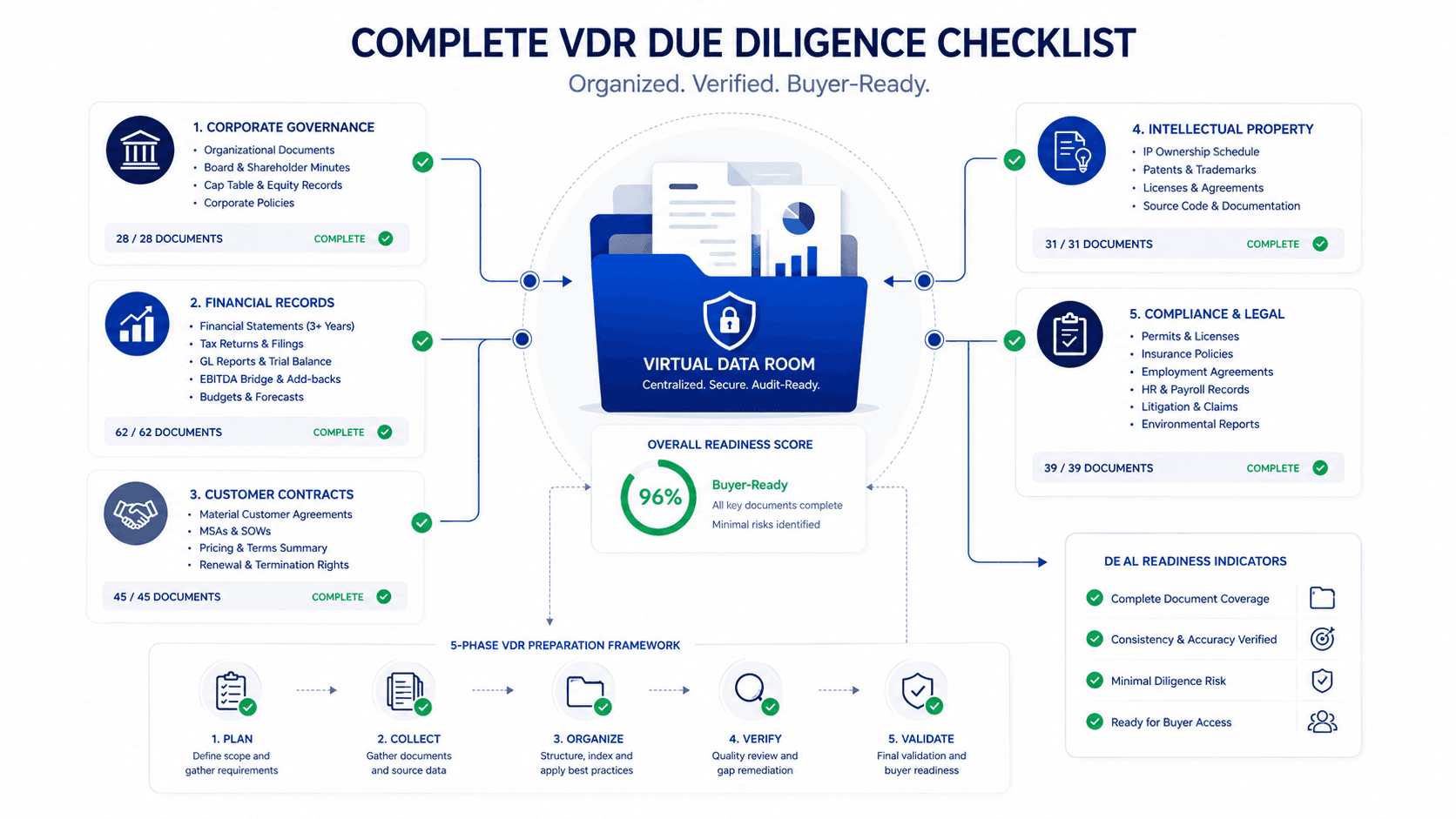
A complete VDR due diligence checklist covers five document categories that institutional buyers require before advancing to LOI:
- Corporate Governance — — entity formation, board minutes, cap table, equity agreements
- Financial Records — — a udited statements, EBITDA normalization, tax returns (3-5 years)
- Customer & Revenue — — top customer contracts, renewal terms, concentration analysis
- Operations & Technology — — IP assignments, software licenses, key vendor agreements
- Legal & Compliance — — litigation history, regulatory filings, employment agreements
Phase 1: Corporate Legal & Governance Documents
Every buy-side legal team opens with a governance review. These documents must be complete, current, and consistently formatted before the VDR launches.
- Articles of Incorporation / Certificate of Formation: Provide the original filing and any subsequent amendments. Confirm the filing state matches the entity's current operating structure.
- Bylaws or Operating Agreement: Include all amendments and board-approved resolutions that modified original governance terms.
- Cap Table and Equity Schedule: Provide a current ownership schedule showing all equity classes, option grants, warrant coverage, and any convertible instruments outstanding.
The cap table must reconcile with the articles on authorized share count. 4. Board Meeting Minutes (3 Years): All regular and special session minutes, including any meetings where executive compensation, related-party transactions, or debt modifications were approved. 5. Subsidiaries and Affiliate Structure: A complete org chart showing all entities, ownership percentages, and jurisdictions of formation. Include any dormant entities that have not been formally dissolved. 6. Foreign Qualifications: Certificates of good standing in each state where the company is registered to do business, dated within 90 days of VDR launch.
⚠️ Common Mistake: Uploading a cap table that does not account for unvested option grants. Buyers will model full dilution scenarios, and a discrepancy between the cap table and the stock option plan will trigger immediate escrow requests.
Phase 2: Financial Records & Tax Compliance
This is the phase where most deals win or lose. Buyers spend 40-60% of their diligence budget here.
- Audited or Reviewed Financial Statements (3 Years): Balance sheets, income statements, cash flow statements, and accompanying notes. If the company uses compilations rather than audits, flag this proactively and offer to provide a quality of earnings engagement letter.
- EBITDA Normalization Bridge with Ledger Support: A formatted bridge document showing each add-back and deduction, with supporting invoices, payroll records, or journal entries attached.
Every line item must be documentable at the source transaction level. 3. Monthly Management Accounts (24 Months): Internal P&L and balance sheet by month, allowing buyers to identify seasonal patterns and revenue concentration months. 4. Federal and State Tax Returns (3 Years): All filed returns including extensions, amended returns, and any IRS correspondence. Confirm alignment between IRS filing records and the financial statements on revenue recognition. 5. Accounts Receivable Aging Schedule: Current aging report with a written explanation for any balances over 90 days.
Include a bad debt reserve methodology memo. 6. Working Capital Analysis: A 13-month rolling working capital bridge showing seasonal fluctuations, supporting the proposed working capital peg in the purchase price adjustment mechanism.
⚠️ Common Mistake: Providing tax returns without the corresponding state filings. Buyers operating in multi-state businesses will cross-reference federal apportionment with state tax nexus filings and will immediately identify missing jurisdictions.
Phase 3: Customer Contracts & Revenue Verification
Revenue quality is the single most scrutinized diligence category in 2026. Buyers want to verify that the revenue in the financial statements is real, recurring, and not dependent on a single customer relationship.
- Top 20 Customer Agreements: Upload the executed master service agreements for your top twenty customers by trailing twelve-month revenue. Redact individual pricing schedules and specific volume commitments for early-stage buyers — release full detail only under LOI.
- Customer Concentration Schedule: A schedule showing each customer's percentage of total revenue for the past three years, anonymized for Tier 1 access and de-anonymized for Tier 2 (LOI stage).
- Contract Renewal Schedule: A forward-looking contract renewal calendar for the next 24 months, flagging any agreements expiring within 6 months of the target closing date.
- Revenue Recognition Policy Memo: A written memo explaining the company's revenue recognition methodology and confirming compliance with applicable accounting standards.
- Backlog or Pipeline Report: For project-based or SaaS businesses, a current pipeline report showing signed contracts not yet recognized as revenue.
⚠️ Common Mistake: Failing to check whether customer contracts contain change-of-control provisions. Many enterprise MSAs require written customer consent before assignment to a new owner — discovering this during confirmatory diligence can delay closing by four to six weeks or require buyer indemnification holdbacks.
Phase 4: Intellectual Property & Technology Stack
For technology-enabled businesses, this phase is often where the most significant valuation risk is buried.
- Patent and Trademark Registrations: Upload USPTO registration certificates for all registered IP. Include pending applications with their filing dates and estimated grant timelines.
- Trade Secret Protection Documentation: Employee NDAs, contractor IP assignment agreements, and any documentation of trade secret protection protocols (access controls, compartmentalization policies).
- Software License Agreements: All material software licenses, both inbound (tools the company uses) and outbound (licenses granted to customers).
Flag any open-source components embedded in proprietary code. 4. Source Code Ownership Confirmation: Signed IP assignment agreements from all developers — employees, contractors, and agencies — who contributed to the core product codebase. 5. Technology Infrastructure Overview: A written description of the technology stack, hosting environment, third-party integrations, and data security architecture.
⚠️ Common Mistake: Uploading source code repositories or detailed architecture diagrams in early-stage VDR access. Strategic buyers are often competitors. Release technical IP documentation only during confirmatory diligence to clean-team counsel, never to the full buyer group.
Phase 5: HR, Compliance & Regulatory Records
- Organizational Chart with Compensation: Current org chart with all FTE and contractor positions. Attach a compensation schedule showing base salary, bonus targets, and equity participation for all roles earning above $100,000.
- Key Employee Agreements: Employment agreements, non-compete covenants, and retention arrangements for the top ten employees by compensation.
Flag any agreements without non-solicitation provisions. 3. Benefits and ERISA Compliance: Summary plan descriptions for health, dental, vision, and retirement plans. If the company sponsors a 401(k), include the most recent Form 5500 filing. 4. Employment Litigation History: Any EEOC complaints, wrongful termination suits, wage and hour disputes, or OSHA citations from the past five years, with resolution documentation. 5. Environmental and Regulatory Permits: All operating permits, environmental compliance records, and any regulatory inspection reports from the past three years. 6. Insurance Policy Schedule: A schedule of all active insurance policies (D&O, E&O, general liability, property, cyber) with coverage amounts and renewal dates.
⚠️ Common Mistake: Failing to include the most recent 401(k) audit report for plans with over 100 participants. ERISA requires annual independent audits, and a missing audit report will trigger an immediate employee benefit compliance flag from the buyer's ERISA counsel.
Manual Checklist vs AI-Assisted VDR Audit: A Comparison
Manual Checklist Approach
- Preparation Time: 6-8 weeks to compile from scratch per engagement
- Gap Detection: Relies on advisor memory and prior deal experience; high risk of category blind spots
- Version Control: Typically managed through email threads and spreadsheet trackers; error-prone
- Buyer Q&A Management: Handled through email and periodic calls; creates inconsistent audit trails
- Cost: High — junior analyst time plus senior advisor review cycles
- Consistency: Varies significantly between engagements and team members
AI-Assisted VDR Audit Approach
- Preparation Time: Structured checklist generated in minutes; gap analysis completed in hours
- Gap Detection: Systematic category coverage with automated flag generation on missing document types
- Version Control: Integrated within the workflow platform; all document versions tracked with timestamps
- Buyer Q&A Management: Centralized Q&A log with automatic escalation routing to the correct advisor
- Cost: Lower marginal cost per engagement; scales across multiple simultaneous deal processes
- Consistency: Standardized output across all engagements regardless of team composition
How AIVI Turns Your Checklist into a Live Remediation Workflow
Running through a VDR due diligence checklist manually is only half the problem. The harder challenge is tracking which gaps have been remediated, which are still pending, and which require client escalation — across multiple deals simultaneously.
This is where advisory teams using the VDR remediation Kanban board at AIVI report the most significant operational improvement. Rather than managing document gaps through email chains and shared spreadsheets, the Kanban converts each checklist deficiency into a structured task with owner assignment, deadline tracking, and status visibility for both the advisor and the client.
When a client completes their exit readiness diagnostic, AIVI's platform cross-references the diagnostic responses against a master VDR document framework, automatically generating a prioritized remediation task list. Advisors can see at a glance which Phase 2 financial documents are pending, which Phase 3 contracts need redaction review, and which Phase 4 IP assignments are outstanding — without a single email.
When preparing financial materials for buyers, advisors can also quantify the acquisition premium a strategic buyer might justify using the Synergy & Premium Estimator — — a free tool that models revenue and cost synergies to help set realistic offer cap expectations. For firms that also need to produce the initial marketing package, the automated CIM drafting feature pulls directly from the diagnostic data, generating a structured first draft that reflects the same normalized EBITDA figures that will appear in the VDR — eliminating the CIM-to-VDR data discrepancy that caused the $4.5M valuation cut in our first case study.
Frequently Asked Questions
What documents are required in a VDR for M&A due diligence?
A complete M&A VDR requires five core categories: corporate legal and governance records (incorporation documents, cap tables, board minutes), financial records (three years of audited financials, tax returns, EBITDA normalization bridge), customer contracts and revenue verification (top customer agreements, concentration schedules, renewal calendars), intellectual property documentation (patent registrations, IP assignment agreements, source code ownership), and HR and compliance records (organizational charts, employment agreements, benefits documentation, insurance schedules). The total document count for a well-packaged lower-middle-market VDR typically runs between 150 and 320 items depending on the business complexity.
How early should sellers start building their VDR due diligence package?
Sellers should begin VDR preparation at minimum six months before the target launch date, and ideally twelve months in advance. Starting early allows time to remediate document gaps, obtain amended tax returns, formalize any customer contract assignments, and execute IP documentation with contractors who may no longer be engaged.
Advisors who launch a VDR within 30 days of engagement have significantly lower close rates and longer diligence timelines compared to those who execute a pre-packaged preparation process.
What is the difference between Tier 1 and Tier 2 VDR access?
Tiered VDR access is a security structure that controls which documents different buyer groups can see based on their stage in the process. Tier 1 access is given to all buyers who have signed a basic NDA; it includes high-level financial summaries, CIM materials, and generic organizational charts.
Tier 2 access is granted after a buyer submits an acceptable Letter of Intent and includes detailed financial records, unredacted customer contracts, key employee compensation, and full IP documentation. This tiering prevents sensitive information from reaching buyers who ultimately do not transact.
How do you handle change-of-control clauses in the VDR?
Change-of-control provisions in customer or vendor contracts must be identified and catalogued before the VDR launches. Your legal counsel should review all material agreements for assignment restrictions or consent requirements that would be triggered by a sale transaction.
Where consent is required, the advisory team should initiate customer notification in coordination with the buyer's counsel as early as the LOI stage — before the VDR opens to the full confirmatory diligence team. Surprises at the confirmatory phase are far more expensive than proactive management at LOI.
What happens if the buyer finds document gaps during due diligence?
Document gaps discovered during active buyer diligence have three potential consequences: they may delay closing by four to eight weeks while remediation occurs, they may trigger indemnification escrow demands that reduce net seller proceeds by 5-15% of enterprise value, or in severe cases they may provide grounds for the buyer to retrade the purchase price or terminate the LOI entirely. This is why pre-launch VDR audits and structured remediation processes are not optional for advisors managing high-stakes transactions.
Disclaimer: The financial and legal information provided in this article does not, and is not intended to, constitute professional legal or financial advice; instead, all information, content, and materials available on this site are for general informational purposes only. Readers should contact their legal counsel or certified public accountant to obtain advice with respect to any particular transaction or regulatory matter.
Ready to automate M&A drafting & secure transaction readiness?
AIVI empowers boutique M&A firms and investment banks to generate CIMs, conduct instant VDR gap checks, and manage exit readiness automatically from a unified data model.